
H2 Chemistry Syllabus 2026 (9729): Complete A-Level Topic Guide
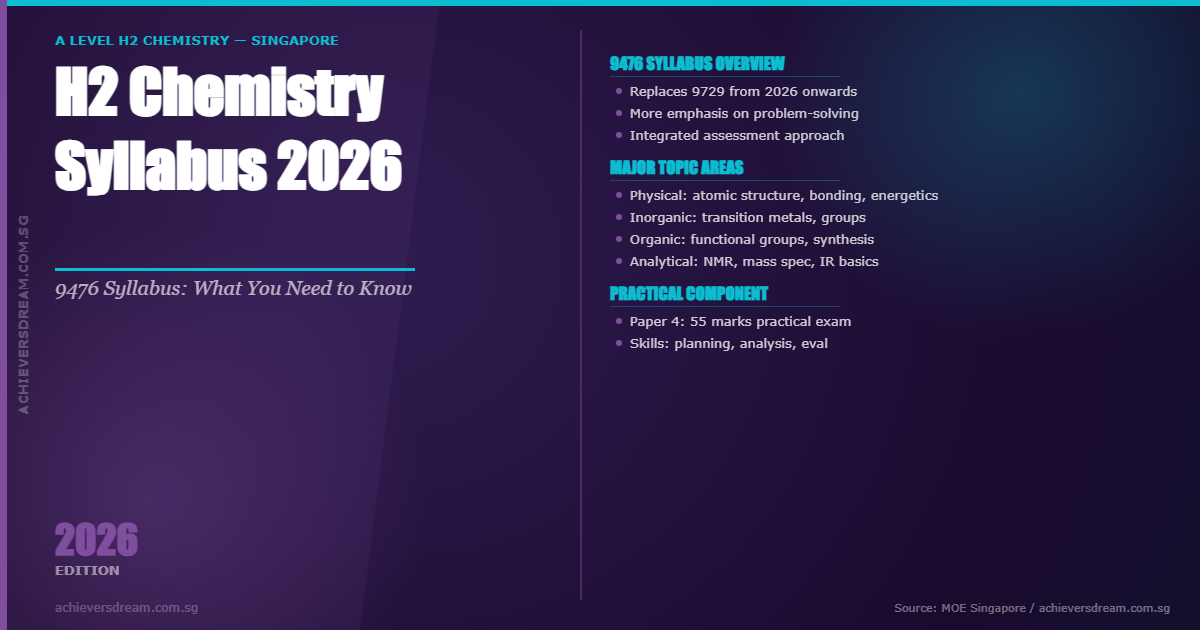
H2 Chemistry Syllabus 2026 (9729): Complete A-Level Guide
This post covers the H2 Chemistry Syllabus 9729, which replaced the previous 9647 syllabus and is the current syllabus for A-Level H2 Chemistry examinations from 2026 onwards. If you are a JC student or tutor, ensure all your revision materials are based on 9729 and not the older 9647.
H2 Chemistry 9729 vs Old 9647: Key Differences
- New topic on Thermodynamics (Gibbs Free Energy, entropy) added
- Revised Electrochemistry chapter with updated electrode potential applications
- Paper structure revised: Paper 1 reduced to 30 MCQ (from 40), Papers 2 and 3 have updated question formats
- Greater weighting on application and analysis questions
- Updated Data Booklet with new values and reference tables
H2 Chemistry 9729 — Full Topic List
Physical Chemistry
- Atomic Structure — Subatomic particles, orbitals, electron configuration, ionisation energy
- Chemical Bonding — Ionic, covalent, metallic bonds; Lewis structures; VSEPR; intermolecular forces
- The Gaseous State — Ideal gas law, kinetic theory, deviations from ideality
- Thermodynamics — Enthalpy, entropy, Gibbs Free Energy, Born-Haber cycles, Hess’s Law
- Introduction to Chemical Equilibria — Kc, Kp, Le Chatelier’s principle
- Ionic Equilibria — Acid-base equilibria, Ka, Kb, pH, buffer solutions, Ksp
- Reaction Kinetics — Rate equations, order of reaction, activation energy, Arrhenius equation
- Electrochemistry — Electrode potentials, galvanic cells, electrolysis, Faraday’s laws
Inorganic Chemistry
- Periodic Table — Trends across Period 3 and down groups
- Group 2 — Physical/chemical properties, reactions, uses
- Group 17 — Halogens, halide chemistry, halogen displacement
- Period 3 — Oxides and chlorides of Period 3 elements
- Transition Elements — Variable oxidation states, complex ions, catalysis, colour
Organic Chemistry
- Introduction to Organic Chemistry — Nomenclature, isomerism, reaction types
- Hydrocarbons — Alkanes, alkenes, arenes
- Halogen Derivatives — Nucleophilic substitution, elimination
- Hydroxyl Compounds — Alcohols, phenols
- Carbonyl Compounds — Aldehydes, ketones
- Carboxylic Acids and Derivatives — Acyl chlorides, esters, amides
- Nitrogen Compounds — Amines, amino acids
- Polymers — Addition and condensation polymers
Paper Structure (9729, 2026)
Paper 1 (1 hour, 30 marks) — 30 multiple choice questions
Paper 2 (2 hours, 80 marks) — Short answer and free-response structured questions. Includes data analysis.
Paper 3 (2 hours, 80 marks) — Free-response questions, some involving planning and evaluating experimental work
Paper 4 — Practical Examination (2.5 hours, 55 marks) — Lab-based practical skills assessment
H2 Chemistry 9729 Assessment Objectives
The examination tests three assessment objectives (AOs): AO1 (Knowledge and Understanding), AO2 (Handling, Applying and Evaluating Information), and AO3 (Experimental Design and Practical Skills).
Preparing for H2 Chemistry 9729
Students should focus on:
- The new Thermodynamics chapter — often tested in Paper 2/3 with multi-step calculations
- Organic chemistry mechanisms — systematic understanding of nucleophilic, electrophilic, and radical reactions
- Practical skills — Paper 4 is examined in the actual lab; NEA-approved lab experience is valuable
Achievers Dream provides H2 Chemistry tuition aligned fully to the 9729 syllabus, including weekly summative lectures and a NEA-approved lab for practical training. Fees from $440/month. Book a free trial today.
Start Your Chemistry Tuition Journey With Achievers Dream
At Achievers dream, we offer specialised Primary Science Tuition, O Level Chemistry Tuition, Lower Secondary Science Tuition and JC Chemistry tuition. Our team consists of ex-MOE HOD’s, NIE teachers and full-time tutors.
As a top tuition centre in Singapore, students will be provided with a wide range of information from sources such as exclusive cheat sheets, sec 1 science notes, science revision guides or other supplementary/topic by topic notes.
Join Our Exclusive Telegram Group Here
Click Here for Free Access to our coloured Chemistry notes
We provide fully customised lessons in conjunction with up-to-date facilities such as our chemistry laboratory and a student portal. Our team will be there for you to support your learning journey, start now and achieve better results