
SALTS PREPARATION
There are 3 common laboratory methods to prepare salts:
1. Precipitation method
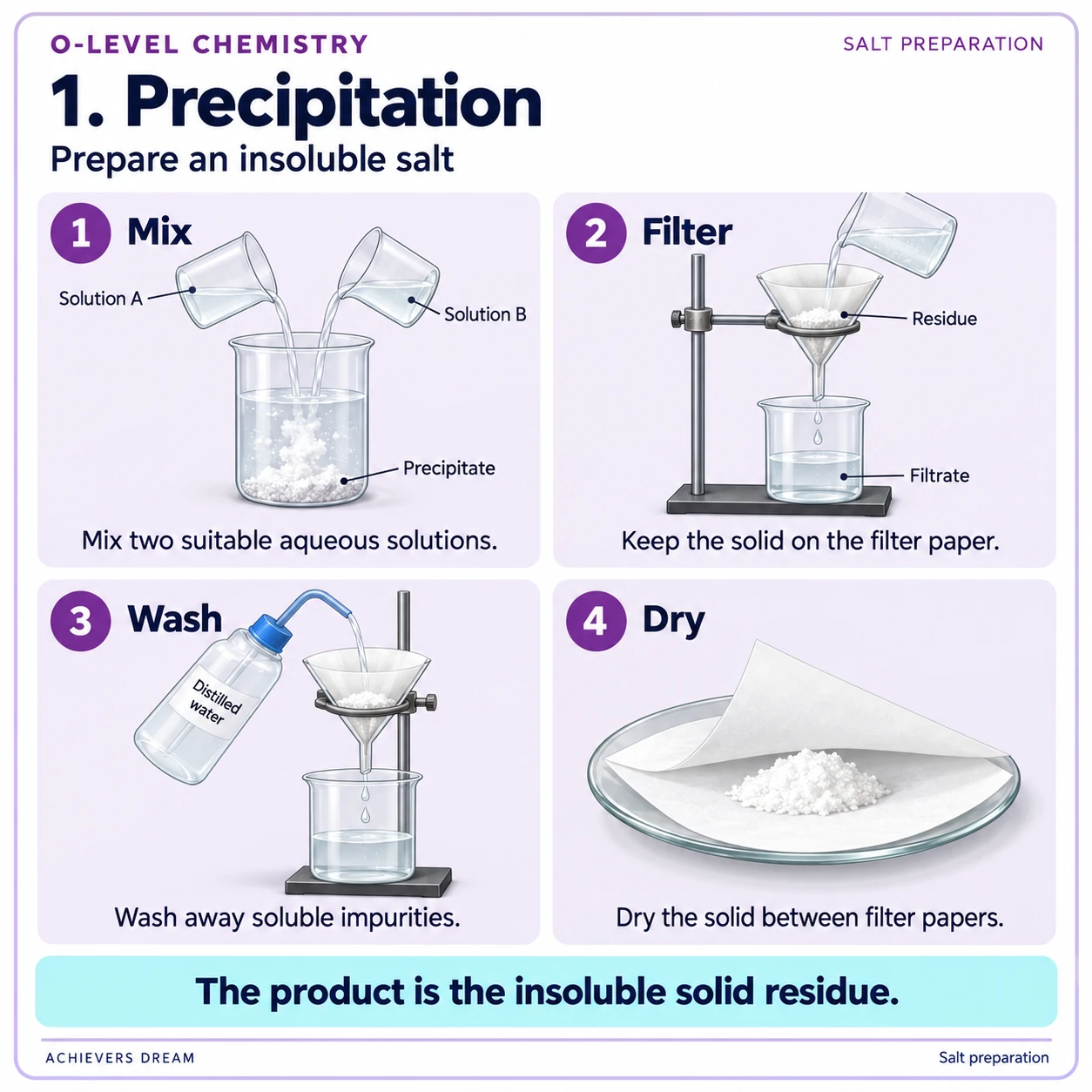
- to produce INSOLUBLE salts
- Reagents: (aqueous) + (aqueous), supplying the required cation and anion.
- Examples: BaSO4, CaSO4, AgCl, PbCl2 etc.
CaSO4 is sparingly soluble in water. These precipitation examples depend on the solubility of the salt and the concentrations of the chosen solutions.
Key steps
- Mix two suitable aqueous solutions to form the insoluble salt as a precipitate.
- Filter the mixture and keep the precipitate on the filter paper.
- Wash the precipitate with distilled water to remove soluble impurities.
- Dry the precipitate.
2. Excess/ICA method
- to produce SOLUBLE salts
- Reagents: a dilute aqueous acid + an excess of a suitable reactive METAL or an INSOLUBLE METAL OXIDE / METAL HYDROXIDE / METAL CARBONATE.
- Note: metals such as Cu/Ag do not displace hydrogen from dilute hydrochloric or sulfuric acid. Group I metals such as Na/K are too reactive for this preparation method.
- Examples: CuSO4, CuCl2, Ba(NO3)2 etc.
Reaction products
- Acid + suitable metal → salt + hydrogen (for the usual dilute hydrochloric or sulfuric acid reactions)
- Acid + metal oxide / metal hydroxide → salt + water
- Acid + metal carbonate → salt + water + carbon dioxide
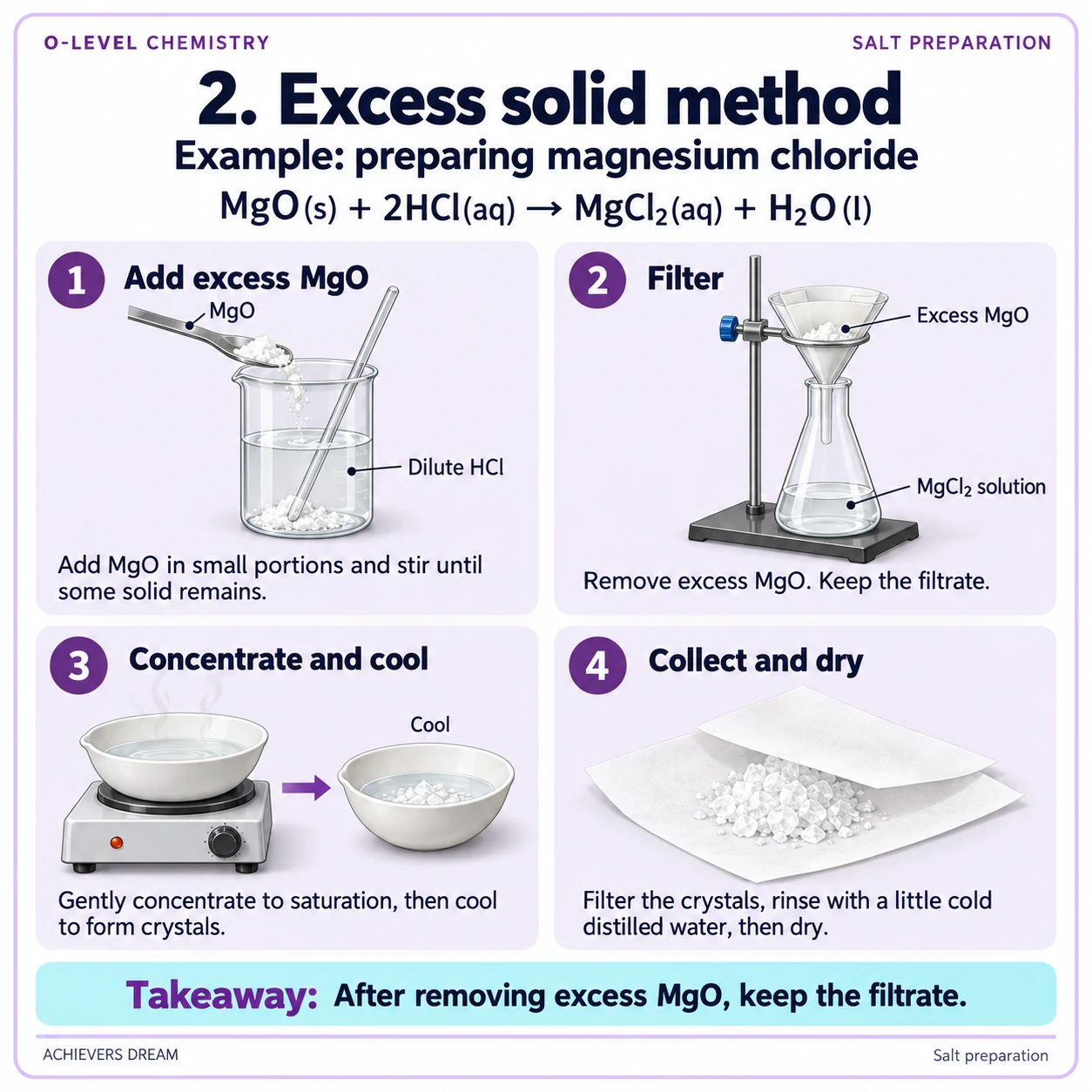
Example: magnesium chloride from magnesium oxide
MgO(s) + 2HCl(aq) → MgCl2(aq) + H2O(l)
- Add magnesium oxide in small portions to dilute hydrochloric acid, stirring until some solid remains undissolved.
- Filter off the excess magnesium oxide. Keep the filtrate containing magnesium chloride solution.
- Gently evaporate some water to obtain a hot saturated solution, then leave it to cool and crystallise.
- Filter to collect the crystals, rinse briefly with a small amount of cold distilled water and dry between filter papers.
3. TITRATION method
- to produce SOLUBLE A1 (Ammonium + Group I) SALTS in common school-laboratory examples, using an acid and an aqueous base.
- Reagents: (aq; acid) + (aq; base)
- Examples: NaCl, KCl, NH4NO3 etc.
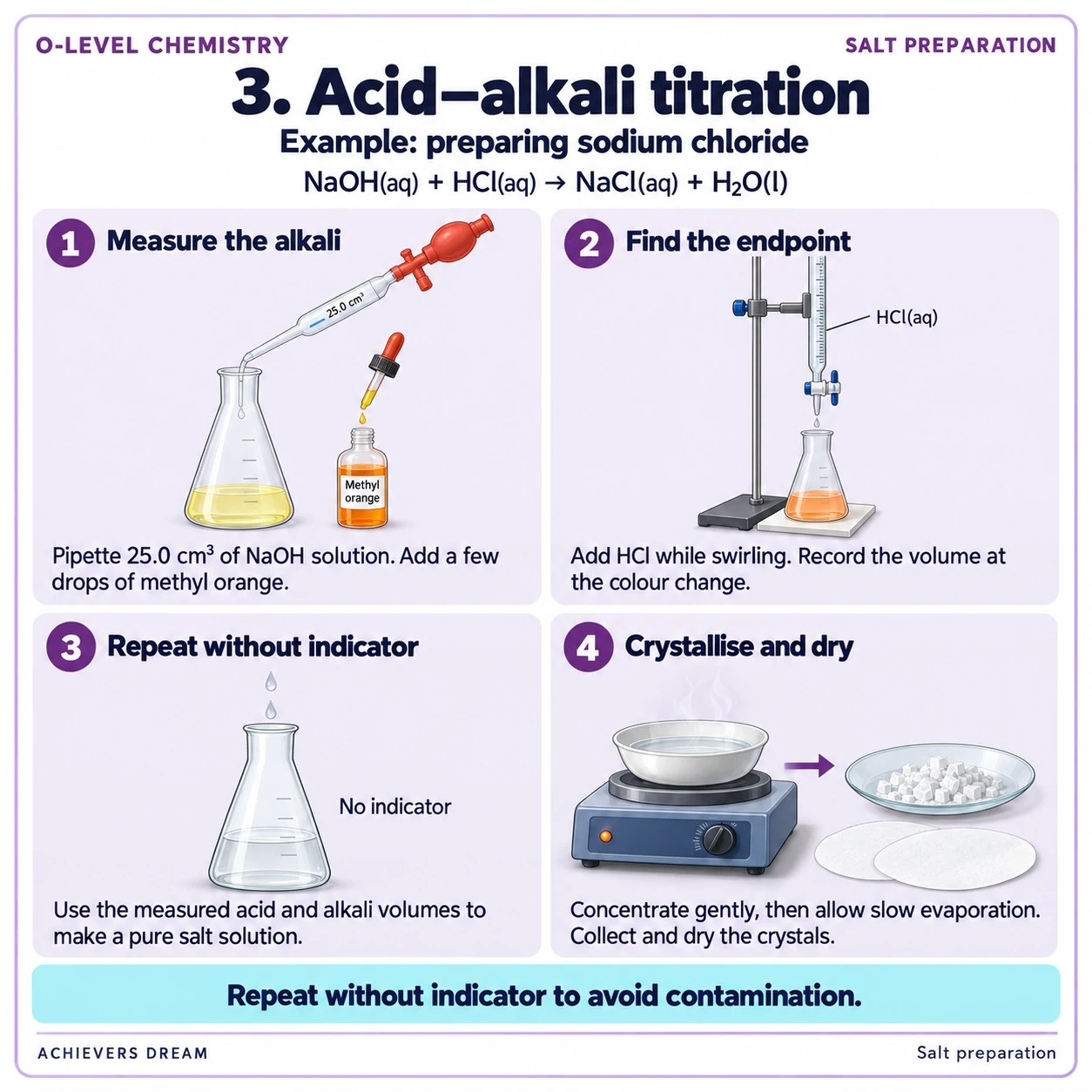
Example: sodium chloride from sodium hydroxide and hydrochloric acid
NaOH(aq) + HCl(aq) → NaCl(aq) + H2O(l)
- Pipette 25.0 cm3 of aqueous sodium hydroxide into a conical flask.
- Add a few drops of a suitable indicator, such as methyl orange for this acid–alkali pair.
- Add hydrochloric acid from a burette, swirling the flask and adding acid dropwise near the endpoint. Record the volume when the endpoint colour change is reached.
- Repeat using the measured volumes of acid and sodium hydroxide, without adding indicator, to obtain an uncontaminated salt solution.
- Gently concentrate the solution, then allow water to evaporate slowly so crystals form. Collect and dry the crystals.
Choose an indicator appropriate to the acid–base pair. The endpoint depends on the indicator; the equivalence-point pH depends on the acid and base.
TIPS
- you have to be very familiar with the solubility table; among the three methods covered here, use PRECIPITATION to produce an insoluble salt.
- However, if the salt you want to produce is soluble, check the reactants as well as the salt. For common ‘A1’ salts, use the TITRATION method with an acid and an aqueous base. For other soluble salts, use the EXCESS method when a suitable reactive metal or insoluble base/carbonate is available.
- Remember A1 (Ammonium + Grp I) to get your A1 in Chemistry
A1 (Ammonium + Group I) is a revision shortcut for common examples. Check the stated solubility information and choose suitable reactants for the salt required.
Start Your Chemistry Tuition Journey With Achievers Dream
At Achievers dream, we offer specialised Primary Science Tuition, O Level Chemistry Tuition, Lower Secondary Science Tuition and JC Chemistry tuition. Our team consists of ex-MOE HOD’s, NIE teachers and full-time tutors.
As a top tuition centre in Singapore, students will be provided with a wide range of information from sources such as exclusive cheat sheets, sec 1 science notes, science revision guides or other supplementary/topic by topic notes.
Join Our Exclusive Telegram Group Here
Click Here for Free Access to our coloured Chemistry notes
We provide fully customised lessons in conjunction with up-to-date facilities such as our chemistry laboratory and a student portal. Our team will be there for you to support your learning journey, start now and achieve better results