
When Is Chemistry Tuition Necessary in Singapore?

Chemistry is one of the few subjects where students often realise they need help only after grades start slipping. Unlike subjects that rely more heavily on memorisation, Chemistry requires students to apply concepts accurately under exam conditions something that becomes increasingly demanding as students move up the academic levels.
In the 2026 academic year, with syllabi already content-heavy and exams continuing to test application and reasoning, many parents ask the same question: When does Chemistry tuition actually become necessary?
The answer depends less on age and more on learning stage and performance signals.
Which Students Usually Benefit Most?
| Stage | Why Tuition May Help |
|---|---|
| Secondary 3 | Chemistry becomes more abstract, with bonding, equations, mole concept, and application questions. |
| Secondary 4 | Students need to close Sec 3 gaps and prepare for O-Level Chemistry under exam pressure. |
| JC1 / JC2 | H2 Chemistry requires deeper reasoning, stronger application, and more precise answering technique. |
Upper Primary (Primary 5–6): Usually Not Necessary
At the primary level, Chemistry concepts are not taught as a standalone subject. Exposure is limited to basic science ideas such as materials, changes, and simple experiments.
At this stage, Chemistry tuition is generally unnecessary. The focus should be on:
- Reading comprehension
- Logical thinking
- Basic scientific observation
However, students who struggle significantly with science explanations or answering open-ended questions may benefit from broader science support not Chemistry-specific tuition.
Secondary 1–2: Usually Not Necessary, But Foundations Matter

In lower secondary, students are introduced to general science concepts that prepare them for subject-based sciences later on.
While formal Chemistry has not begun, this is where learning habits are formed.
Chemistry tuition is typically not required at this stage (given that students are still easing into the subject) unless:
- The student struggles to understand explanations in science
- There are consistent difficulties with answering structured questions
- The student relies heavily on memorisation without understanding
Secondary 3 (O Level Chemistry Begins): Often Necessary
This is the most critical transition point.
In Sec 3, students encounter:
- Abstract concepts (particles, atomic structure, bonding)
- Chemical equations and calculations
- Structured answering techniques required by SEAB
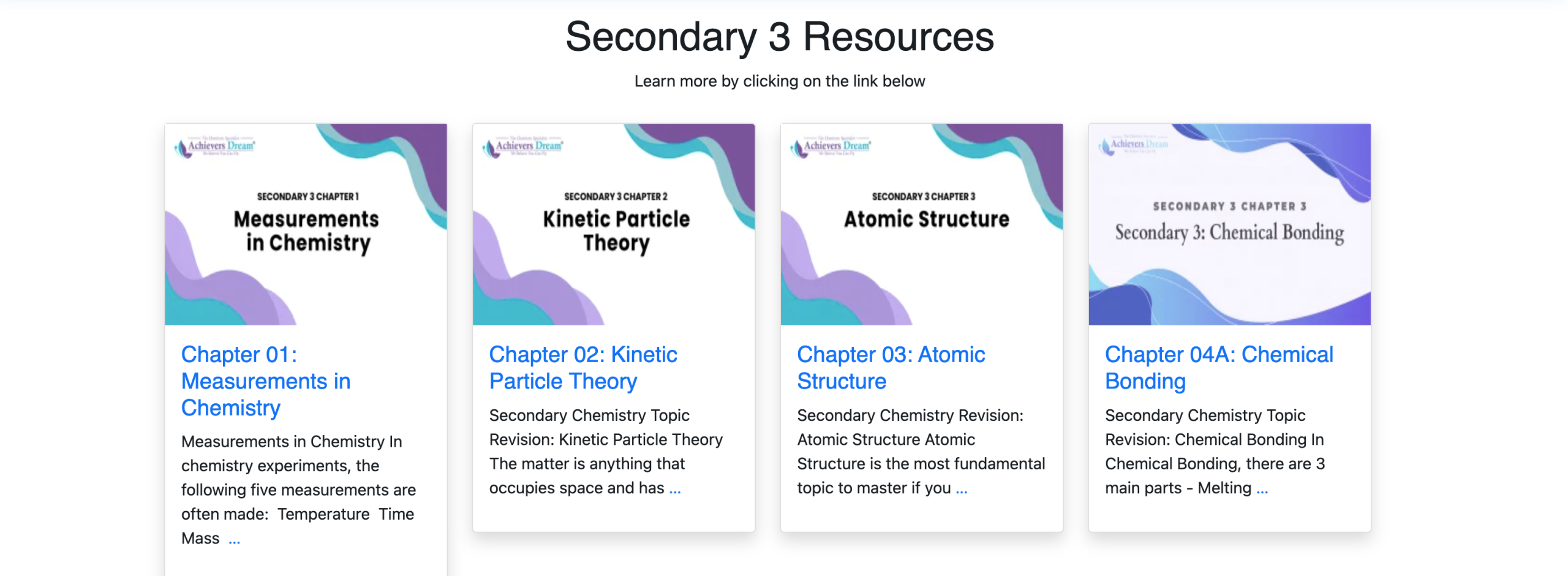
Refer to Sec 3 Chemistry Free Resources here.
Many students appear to cope initially, only to experience a sharp drop in results mid-year. This is one of the most common points where Chemistry tuition becomes necessary.
Warning Signs in Secondary 3
Many students cope initially before experiencing a sudden drop in results as Chemistry becomes more abstract and application-based.
📚 Concepts still feel confusing despite repeated revision
📉 Test results do not reflect the amount of effort invested
🧠 Notes are memorised but cannot be applied to unfamiliar questions
⚠ Growing fear, frustration or avoidance of Chemistry lessons
Secondary 4 (O Level Year): Frequently Necessary
What O-Level Chemistry Expects
Apply concepts across multiple topics
Handle unfamiliar question settings
Manage time pressure during examinations
When Tuition Becomes Particularly Important
📉 Grades remain inconsistent or continue declining
✍ Lack of confidence in structured and data-based questions
🧩 Secondary 3 knowledge gaps remain unresolved
JC1 (H2 / H1 Chemistry): Often Necessary, Even for Strong Students

JC Chemistry represents a significant jump in difficulty.
Many students who did well in O Level Chemistry struggle in JC because:
Why Many Strong O-Level Students Struggle in JC Chemistry
JC Chemistry is not simply a harder version of O-Level Chemistry. The way students are expected to think changes significantly.
🧪 Concepts become more theoretical and interconnected
📝 Questions require deeper explanation and scientific reasoning
⚡ Application replaces familiar and routine question types
Chemistry tuition is commonly necessary in JC1 if:
Common JC1 Experiences
“I understand the lecture, but cannot do the tutorial.”
“My grades dropped from A/B in secondary school to D/E/S in JC.”
“I know the content but cannot explain my answers properly.”
“I spend hours memorising but still struggle with application questions.”
JC2 (A Level Year): Necessary for Recovery or Grade Optimisation
By JC2, students usually fall into two groups:
- Those aiming to recover from weak foundations
- Those aiming to push grades from average to distinction
Chemistry tuition in JC2 is often necessary when:
- There are persistent conceptual gaps
- Exam technique is weak despite understanding
- Time management and application under pressure are issues
In the A Level context, small mistakes can cost entire grade bands. Structured guidance helps students refine accuracy, clarity, and exam confidence.
Signs Chemistry Tuition May Be Necessary (Any Level)
Regardless of academic level, Chemistry tuition may be helpful when students put in consistent effort but see little improvement in their results.
It is also commonly needed when answers are frequently marked down for “lack of explanation”, or when there is growing anxiety around tests and examinations.
Parents may also notice increasing avoidance, frustration, or loss of confidence in the subject.
Quick Summary
Chemistry tuition is usually most useful when a student struggles with application, answering technique, practical interpretation, or exam confidence — not just memorisation.
When Chemistry Tuition May Not Be Necessary
Not every student requires Chemistry tuition.
- Consistently performing well across school assessments.
- Able to explain concepts clearly without assistance.
- Comfortable applying concepts to unfamiliar questions.
- Maintaining strong grades while managing workload confidently.
In such cases, independent revision and targeted consultation may be sufficient.
What Chemistry Tuition Should Actually Build
One of the most overlooked benefits of tuition is the role it plays in cultivating thinking habits. Chemistry exams don’t simply ask for facts, they require students to:
- Predict outcomes based on incomplete information
- Justify reasoning using scientific principles
- Integrate theory with observed behaviour
- Adjust thinking when confronted with novel problem types
A support programme that emphasises these cognitive dimensions doesn’t just prepare students for the next test — it builds scientific fluency that benefits future learning in related fields like biology, physics, engineering, and medicine.
The Role of Practical Work in Understanding Chemistry
One of the unique aspects of an enriched tuition model is the integration of hands-on practical work, set up to mirror real exam and lab conditions.
At Achievers Dream, students have access to dedicated chemistry lab sessions that go beyond textbook theory, blending foundational science with physical experience.
Experiential learning — where students observe reactions, manipulate apparatus, and interpret their own data — can transform Chemistry from a static set of facts into a coherent, dynamic process. Research in science education suggests that inquiry-based engagement helps students develop independent reasoning skills, not just memorise content.
Thinking Beyond Tuition: Cultivating Chemistry Learners
Instead of asking “Do I need tuition?”, consider questions that signal long-term growth:
- Am I consistently able to explain underlying chemistry principles in my own words?
- Can I apply concepts to unfamiliar problems without memorising steps?
- Do I understand how theory connects with real experimental data?
- Am I developing confidence in scientific thinking, not just test performance?
If answers to these point toward confusion or inconsistency, then structured support whether through tuition, peer study groups, or guided independent practice becomes less of an optional “extra” and more of a learning strategy choice.
A Better Question To Ask
Instead of asking:
“Does every student need Chemistry tuition?”
Ask:
“Can this student achieve their target grade without additional support?”
The answer varies from student to student. The key is identifying challenges early enough for meaningful improvement to take place.
Should You Consider Chemistry Tuition?
Am I consistently losing marks despite studying?
Do I understand lessons but struggle with exam questions?
Have my Chemistry results plateaued for several tests?
Am I worried about O-Level or A-Level Chemistry performance?
Start Your Chemistry Tuition Journey With Achievers Dream
At Achievers dream, we offer specialised Primary Science Tuition, O Level Chemistry Tuition, Lower Secondary Science Tuition and JC Chemistry tuition. Our team consists of ex-MOE HOD’s, NIE teachers and full-time tutors.
As a top tuition centre in Singapore, students will be provided with a wide range of information from sources such as exclusive cheat sheets, sec 1 science notes, science revision guides or other supplementary/topic by topic notes.
Join Our Exclusive Telegram Group Here
Click Here for Free Access to our coloured Chemistry notes
We provide fully customised lessons in conjunction with up-to-date facilities such as our chemistry laboratory and a student portal. Our team will be there for you to support your learning journey, start now and achieve better results