
Speed Of Reaction
The Speed of Reaction is a measure of how quickly a reaction takes place.
Enrol now Learn moreThe Speed of Reaction is a measure of how quickly a reaction takes place.
The 5 factors affecting speed of reaction that we will cover in this topic are:
- Temperature
- Concentration of aqueous reactant (Only applies to aqueous reactants).
- Pressure of gaseous reactant (Only applies to gaseous reactants)
- Particle size of reactant (Only applies to solid reactants)
- Presence of catalyst
1. Temperature

Question 1
The effects of a change in conditions on a chemical reaction are listed.
1. The total number of collisions per minute increased.
2. The number of effective collisions per minute increased.
3. The average energy of the particles increased.
4. The activation energy increased.
Which of the above effects are resulted by an increase in temperature?
A. 1, 2, 3 and 4
B. 1, 2 and 3 only
C. 1 and 2 only
D. 3 and 4 only
Explanation
An increase in temperature increases the average energy of the reactant particles. As a result, the reactant particles move faster, colliding into each other
more often, which increases the total number of collisions per minute and increases the number of effective collisions per minute. However, the activation
energy remains the same as it is not affected by a change in temperature.
Hence, answer is B (1, 2 and 3 only).
2. Concentration of aqueous reactant (Only applies to aqueous reactants)

Question 2
100 cm3 of 0.5 mol/dm3 dilute hydrochloric acid was added to 2 g of magnesium carbonate.
Which of the following changes would increase the initial rate of formation of carbon dioxide?
A. Adding 20 cm3 of deionized water to the original acid
B. Adding another 10 cm3 of 0.5 mol/dm3 hydrochloric acid
C. Adding 10 cm3 of 2 mol/dm3 dilute hydrochloric acid to the original acid
D. Lowering the temperature
Explanation
A:- ✗ Adding 20 cm3 of deionized water to the original acid would decrease the concentration of the original acid, which would decrease the
rate reaction and decrease the initial rate of formation of carbon dioxide.
B:- ✗ No. of mol of HC𝑙 in initial solution = 100/1000 × 0.5 = 0.0500 mol/dm3
No. of mol of HC𝑙 in final solution = (10/1000 × 0.5) + 0.0500 mol = 0.0550 mol
Concentration of HC𝑙 in final reaction mixture = 0.0550/110/ 1000 = 0.500 mol/dm
As there is no increase in concentration, rate of reaction would not increase and initial rate of formation of carbon dioxide would not increase.
C: ✗ No. of mol of HC𝑙 in final solution = (10/1000 × 2) + 0.0500 mol = 0.0700 mol/dm3
Concentration of HC𝑙 in final reaction mixture = 0.0700/110/1000 = 0.636 mol/dm3
Adding 10 cm3 of 2 mol/dm3 dilute hydrochloric acid to the original acid would increase the concentration of the original acid, which would increase the rate of reaction and would increase the initial rate of formation of carbon dioxide.
D:- ✗ Lowering the temperature would decrease the rate of reaction, which would decrease the initial rate of formation of carbon dioxide.
3. Pressure of gaseous reactant (Only applies to gaseous reactant)

Question 3
Which change would increase the speed of reaction between two gases?
A. A decrease in surface area of the catalyst
B. A decrease in temperature
C. A decrease in the size of the reaction flask
D. A decrease in the pressure of the gases
Explanation:
A:- ✗ A decrease in surface area of the catalyst may or may not affect the speed of reaction between two gases. Thus, this change is inconclusive.
B:- ✗ A decrease in temperature would decrease the speed of reaction between two gases.
C:- ✓ A decrease in the size of the reaction flask would increase the pressure of the gases and thus, increase the speed of reaction between two gases.
D:- ✗ A decrease in the pressure of the gases would decrease the speed of reaction between two gases.
4. Particle size of reactant (Only applies to solid)

Question 4
In the reaction between zinc and hydrochloric acid, the following changes could be made to the conditions.
1. Increase in concentration of the acid
2. Increase in particle size of the zinc
3. Increase in pressure of the system
4. Increase in temperature of the system
Which pair of changes will increase the rate of reaction?
A. 1 and 2
B. 1 and 4
C. 2 and 3
D. 3 and 4
Explanation
1:- ✓ Increase in concentration of the acid will increase the rate of reaction.
2:- ✗ Increase in particle size of the zinc will decrease the rate of reaction.
3:- ✗ Increase in pressure of the system will only increase the rate of reaction for gaseous reactants. However, zinc and hydrochloric acid are solid and aqueous reactants respectively. Therefore, in the reaction between zinc and hydrochloric acid, increase in pressure of the system will not increase the rate of reaction.
4:- ✓ Increase in temperature of the system will increase the rate of reaction.
Hence, Answer is B(1 and 4).
Presence of catalyst
A catalyst is a substance that increases the rate of a chemical reaction but itself remains chemically unchanged at the end of the reaction.
Biological catalysts are known as enzymes.


Question 5
How will the addition of a catalyst affect the energy of the particles and the activation energy of the reaction?
| Energy of Particles | Activation energy | |
|---|---|---|
| A | Remains the same | Remains the same |
| B | Remains the same | Decreases |
| C | Increases | Remains the same |
| D | Increases | Decreases |
Explanation:
A catalyst decreases the activation energy required for the reaction to occur. The
energy of particles remains the same as the temperature of the system remains
the same.
Hence, answer is B.
There are many ways to measure the speed of a chemical reaction. The 2 commonly used methods that are covered in this topic are:
1. Measuring how much product is formed over time
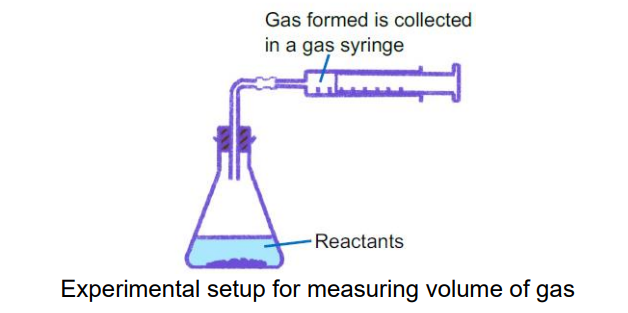
The volume of the gas produced is measured using the gas syringe over time.
2. Measuring how much reactants are used up over time

The gas produced escapes from the solution and is represented by the loss in mass of the reaction vessel. Rate of gas production is then measured.
Question 6
When calcium carbonate is added to dilute hydrochloric acid, carbon dioxide gas is released.
Three sets of apparatus are shown.

Which set(s) of apparatus is/are suitable, together with a stopwatch, for following the rate of this reaction?
A: 1 only
B: 2 only
C: 1 and 2 only
D: 1,2, and 3
Explanation:
1: ✓
The carbon dioxide gas released escapes from the solution and is represented by the loss in mass of the reaction vessel. This set of apparatus is an experimental setup for following the rate of the reaction between calcium carbonate and dilute hydrochloric acid by measuring the loss in mass.
B: ✓
This set of apparatus is an experimental setup for following the rate of the reaction between reaction between calcium carbonate and dilute hydrochloric acid by collecting the carbon dioxide gas produced in the gas syringe and the rate of gas production is then measured.
C: ✗
The volume of carbon dioxide gas produced cannot be accurately measured by a measuring cylinder as it may also escape via the thistle funnel.
Hence, answer is C (1 and 2 only).
Interpreting graphs (Reactant vs products graph)
The rate of a reaction within any chemical reaction is never constant. It is usually fastest at the start of the reaction and slower towards the end of the reaction, eventually stopping together.
The rate of reaction is represented by the gradient of the curve. The steeper the gradient is, the faster the rate of reaction.
The typical graph for the rate of reaction where H2 gas is produced in an acid-metal reaction is shown below.

The rate of reaction is the fastest at the beginning of the reaction (time = 0), when the concentration of reactants is the highest.
As the reaction progresses, reactants are continually being converted into products. Hence, the concentration of reactants decreases, resulting in a decreasing rate of reaction and the gradient gets less steep or more gentle.
The reaction eventually stops when the limiting reagent has been completely used up, resulting in gradient = 0.
Question 7
A student investigates the rate of reaction between marble chips and excess hydrochloric acid by measuring the loss in mass of the reaction flask.
The graph shows the results of two experiments, P and Q.

Which change best explains the difference between P and Q?
A. A catalyst is added in P.
B. A higher temperature is used in P.
C. A lower concentration of hydrochloric acid is used in Q.
D. Smaller pieces of marble chips are used in Q.
Explanation:
The gradient of the curve represents the rate of the reaction. The steeper the gradient, the faster the rate of reaction. Since Q has a steeper gradient than P, Q has a faster rate of reaction than P.
A: ✗
Addition of a catalyst in P increases the rate of reaction in P but the graph shows that P has a slower rate of reaction than Q.
B: ✗
Using a higher temperature in P increases the rate of reaction in P but the graph shows that P has a slower rate of reaction than Q.
C: ✗
Using a lower concentration of hydrochloric acid in Q decreases the rate of reaction in Q but the graph shows that Q has a faster rate of reaction thanP.
D: ✓
Using smaller pieces of marble chips in Q increases the rate of reaction in Q and the graph shows that Q has a faster rate of reaction than P.

What are the three reactions that can result in an S-shape graph?
1. A strip of magnesium may have an insoluble oxide layer, thus, the reaction speeds up as the oxide layer is dissolved.
2. A temperature rise due to an exothermic reaction can speed up the reaction in the first few minutesp.
3. One of the products of the reaction acts as a catalyst (‘autocatalyst), hence the reaction speeds up as the first trace of products are formed.
Question 8
In autocatalysis, a chemical reaction is catalysed by one of its products. An example is the reaction between oxalic acid, (COOH)2, and acidified potassium manganate (𝑉𝐼𝐼).
5(COOH)2 + 6H+ + 2MnO4- → 2Mn2+ + 10CO2 + 8H2O
The reaction is very slow at room temperature, but it is catalysed by Mn2+ ions that are produced during the reaction.
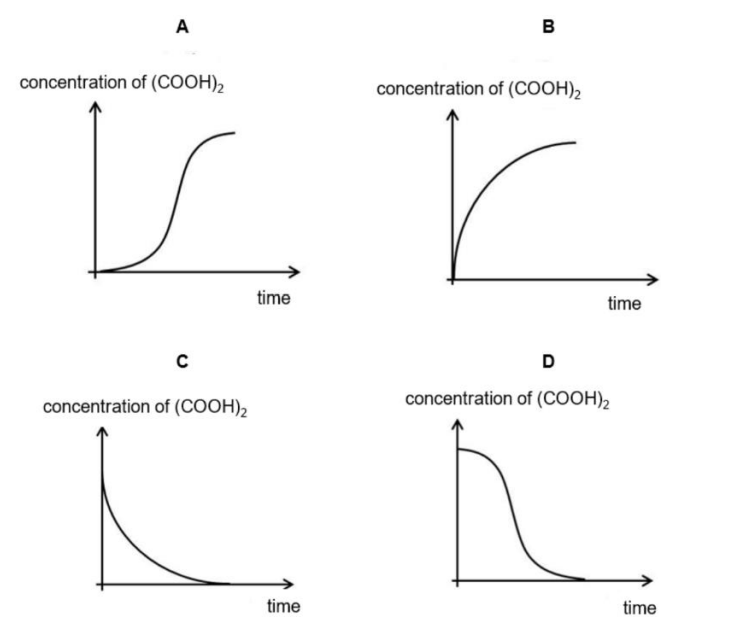
Which graph correctly shows the changes in concentration of (COOH)2 as the reaction proceeds?
Explanation:
Since (COOH)2 is a reactant, it is used up in this reaction and its concentration should decrease as the reaction proceeds. Thus option A and B are eliminated. The gradient of the curve represents the speed of the reaction. The steeper the gradient, the faster the speed of reaction. After the reaction starts, Mn2+ ions that are produced during the reaction act as a catalyst. Thus, the reaction speeds up after the first trace of Mn2+ is formed and the gradient of the curve becomes steeper. As the reaction progresses, reactants are continually being converted into products. Hence, the concentration of reactants decreases, resulting in a decreasing rate of reaction and the gradient of the curve becomes gentler. The concentration of (COOH)2 eventually decreases to 0 when it has been completely used up.
Hence, answer is D.