

The assessment for the syllabus focuses on both content knowledge and process skills. Students are tested on their ability to analyze, infer, and explain phenomena through multiple-choice and structured questions, including written explanations.
In this article, we break down what is assessed in PSLE Science, the key skills students need to develop, and how the exam is structured to gauge their readiness for secondary school.
Two different kinds of weighting are discussed below. The national PSLE Science examination is a written paper. The recommended balance between written tests and performance-based work in the MOE syllabus is for school-based assessment; it is not the national PSLE mark allocation.
What Is Assessed and How Is It Assessed?
2026 PSLE Standard Science Examination Format
The published SEAB 2026 examination format does not assign a fixed percentage of marks to each Science topic. The 60% / 40% split below is between the two booklets, not between topics. Revise the full syllabus rather than treating a topic-percentage prediction as an official requirement.
| Booklet and question format | Questions | Marks per question | Total marks | Share of paper |
|---|---|---|---|---|
| Booklet A: Multiple-choice (four options) | 30 | 2 | 60 | 60% |
| Booklet B: Structured | 10–11 | 2–5 | 40 | 40% |
Total: 100 marks. The 60% and 40% shares are calculated from the two booklet totals, not from topic allocations.
Both booklets form one paper lasting 1 hour 45 minutes. Candidates must answer every question. Source: SEAB Standard Science examination format from 2026.
Foundation Science has a separate format. In 2026, Booklet A has 20 multiple-choice questions worth 40 marks; Booklet B has 9–11 short-response and structured questions worth 30 marks. The 70-mark paper lasts 1 hour 15 minutes. A word list is provided. See the SEAB Foundation Science format.
How Is Primary Science Assessed in School?
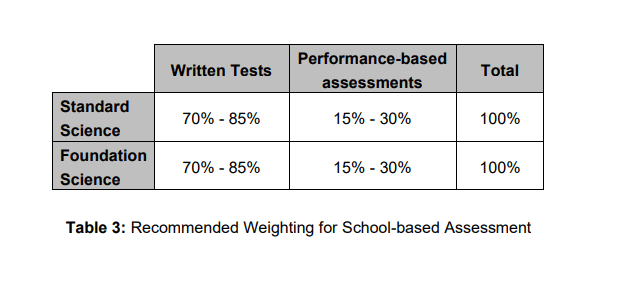
The MOE Primary Science Teaching & Learning Syllabus, implemented from the 2023 Primary 3 cohort and updated in January 2026, gives the following recommended weighting for school-based assessment in Standard and Foundation Science. The percentages divide written tests and performance-based assessments; they are not PSLE topic or year-level weightages. The two assessment components together total 100%.
Primary Science Syllabus 2023: Recommended School-Based Assessment Weighting
| Science course | Written Tests | Performance-based assessments | Total |
|---|---|---|---|
| Standard Science | 70% – 85% | 15% – 30% | 100% |
| Foundation Science | 70% – 85% | 15% – 30% | 100% |
These are recommended ranges for a school-based assessment mix totalling 100%, not two independently chosen percentages. Source: MOE Primary Science Syllabus, Table 3, printed page 35.
What Performance-Based Assessments Can Teachers Use in School?
The aims of the Primary Science Syllabus are for students to acquire Science concepts, develop skills and cultivate values, ethics and attitudes and apply them in authentic, relevant daily life contexts.
In the teaching and learning of Science, assessment can take many forms. In addition to the written tests, teachers can also conduct performance-based assessment using the following modes:
- Checklists
- Debates
- Drama / Show and Tell
- Games and Quizzes
- Learning Trails
- Model-making
- Posters
- Practicals
- Projects
- Reflections / Journals
- Teacher Observations
Portfolios and Student Reflection
Teachers can also assess students’ learning using portfolios. It is a systematic and purposeful collection of students’ work and provides a comprehensive picture of their development and progress in the acquisition of knowledge, understanding of scientific concepts, application of skills, and development of attitudes.
Students can select the pieces which will go into the portfolio which provides opportunity for the students to have self-evaluation and reflections by revisiting their own portfolio of their work. The assessment modes listed above are by no means exhaustive. Adopting a variety of assessment modes enables the teachers to assess different aspects of teaching and learning.
Sources and Related Reading
Sources checked: 2 November 2026.
Official Sources
Start Your Chemistry Tuition Journey With Achievers Dream
At Achievers Dream, we offer specialised Primary Science Tuition, O Level Chemistry Tuition, Lower Secondary Science Tuition and JC Chemistry tuition. Our teaching team includes former MOE Heads of Department, NIE-trained teachers and full-time tutors.
As a tuition centre in Singapore, students will be provided with a wide range of information from sources such as exclusive cheat sheets, sec 1 science notes, science revision guides or other supplementary/topic by topic notes.
Join Our Exclusive Telegram Group Here
Click Here for Free Access to our coloured Chemistry notes
We provide structured lessons with personalised support, alongside facilities such as our chemistry laboratory and a student portal. Our team will be there for you to support your learning journey, start now and achieve better results