
Chapter 17: Crude Oil and Hydrocarbons
Organic Chemistry 1 (Crude Oil and Hydrocarbons)
Fractional distillation of crude oil
Crude oil is a mixture of a variety of liquid and gaseous hydrocarbons with different boiling points. By using fractional distillation, we can separate crude oil into its different useful fractions.

Each fraction contains a mixture of hydrocarbons which has a different boiling point range. Crude oil is heated in a furnace and vapourised. Hot vapour flows up the fractionating column. As it cools down, each fraction condenses when the temperature of the column is lower than its boiling point.
– Lighter fractions with lower boiling point ranges will distil at the top of the column
– Heavier fractions with higher boiling point ranges will distil at the bottom of the column
Trend of increasing carbon atoms in homologous series or crude oil fractions
Melting and boiling point: Increasing number of carbon atoms → more electrons → intermolecular forces become stronger → more energy required to overcome → higher melting / boiling point
Density: Increasing number of carbon atoms → higher density
Viscosity: Increasing number of carbon atoms → more electrons → intermolecular forces become stronger → more difficult for substance to flow → higher viscosity
Flammability: Increasing number of carbon atoms → more bonds are required to break → lower flammability
Question 2 (Admiralty Sec)
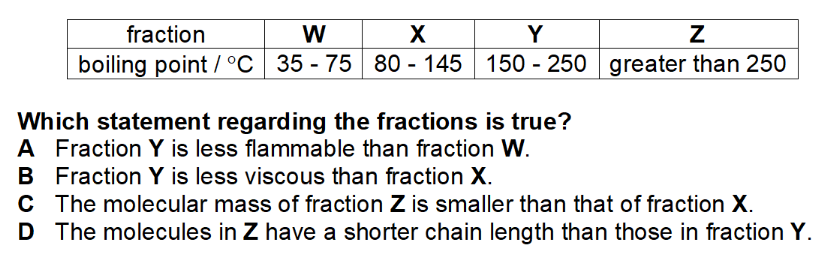
Answer
The fractions are arranged in increasing boiling points from W to Z. This means W is distilled at the top of the fractionating column and has the smallest Mr while Z is distilled at the bottom and has the highest Mr.
B is not the answer as Y has more carbon atoms and electrons than X, resulting in stronger intermolecular forces. This makes Y more difficult to flow, thus Y should be more viscous than X.
C is not the answer as Z has more carbon atoms and thus should have a higher molecular mass than X.
D is not the answer as Z has more carbon atoms and thus should have a longer chain length than X.
A is the answer as Y has more carbon atoms and bonds that are required to break than W; thus Y should be less flammable than W.
Introduction (Homologous Series)
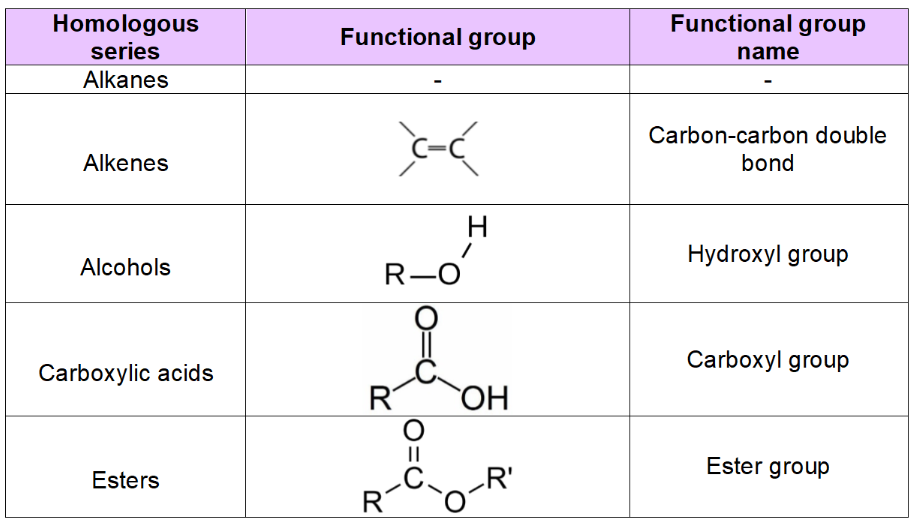
Organic compounds are compounds that contains carbon and hydrogen. Sometimes they can also contain oxygen, nitrogen or halogens. Organic compounds are grouped into homologous series.
Homologous series:
A family of organic compounds which have
1. the same general formula with
2. each member differing from the next by a -CH2 group.
3. the same functional group and hence,
4. have similar chemical properties.
Isomers: Compounds with the same molecular formulae but different structural formulae.
Question 1 (Admiralty Sec)
The structural formula of compound Z is shown.

Answer
Compound Z has 5 carbon, 12 hydrogen and 1 oxygen atoms. An isomer of Z would have the same molecular formula of C5H12O but different structural formula.
Both A and B is not the answer as they have a different molecular formula of C5 H10O.
D is not the answer as it has a different molecular formula of C4H10O.
C is the answer as it has a same molecular formula of C5H12O with a different structural formula (the way the atoms are arranged are different).
Naming of organic compounds
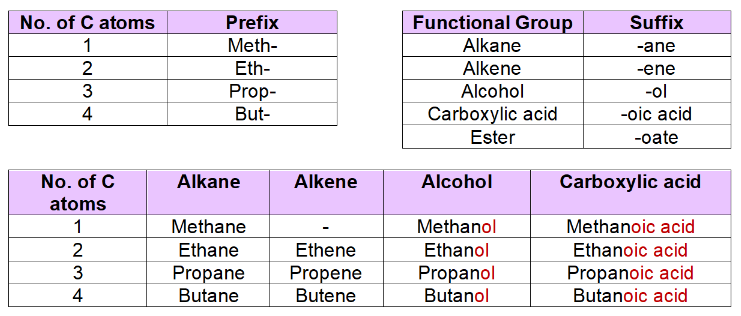
Organic compounds are named from the number of carbon atoms which determines the prefix and the functional group which determines the suffix.
Alkanes
They are hydrocarbons (only containing carbon and hydrogen) with the general formula CnH2n+2.
Characteristics
- low melting / boiling points
- insoluble in water
- soluble in organic solvents
- saturated (C-C)
Chemical properties of alkanes
1. Combustion
Examples:
- Complete combustion: CH4 (g) + 2O2 (g) → CO2 (g) + 2H2O (𝑙)
- Incomplete combustion: 3CH4 (g) + 5O2 (g) → CO2 (g) + 2CO (g) + 6H2O (𝑙)
or
-
- 2CH
-
- (g) 3O
-
- (g) → CO
-
- (g) + C (s) + 4H
- O (𝑙)
Reactants: Oxygen
Conditions:
Alkanes tend to undergo incomplete combustion as the number of carbon atoms increase.
2. Substitution
Examples:
- CH4 + C𝑙2 → CH3C𝑙 + HC𝑙
- CH4 + Br2 → CH3Br + HBr
Reactants: C𝑙2 (g) or Br2 (𝑙)
Conditions: UV light
Alkanes can go through multiple substitutions to form CH2C𝑙2, CHC𝑙3, CC𝑙4
Alkenes
They are hydrocarbons (only containing carbon and hydrogen) with the general formula CnH2n and contain the functional group C=C.
Characteristics
- low melting / boiling point
- insoluble in water
- soluble in organic solvents
- unsaturated (C=C)
Formation of alkenes
Alkenes are manufactured by cracking, which involves breaking down long-chain hydrocarbons into short-chain hydrocarbons and/or hydrogen.
Examples:
- C18H38 → C8H16 + C10H20 + H2
- C12H26 → C4H8 + C8H16 + H2
Reactants: –
Conditions: A𝑙2O3 or SiO2 powder as catalyst, high temperature (500°C)
Chemical properties of alkenes
1. Combustion
Examples:
- Complete combustion: C2H4 (g) + 3O2 (g) → 2CO2 (g) + 2H2O (𝑙)
Reactants: Oxygen
Conditions:
A higher percentage of carbon in alkenes causes it to combust with a sootier flame as compared to alkanes
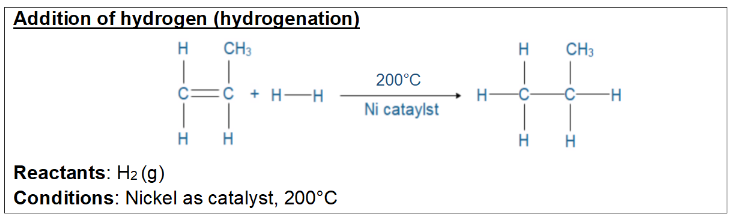
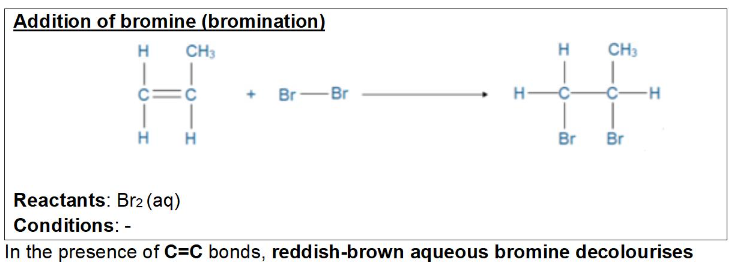
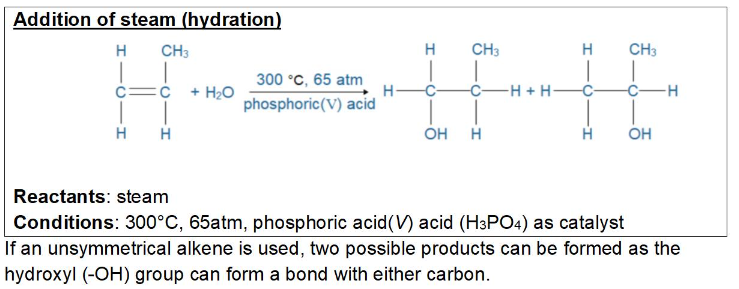
2. Addition
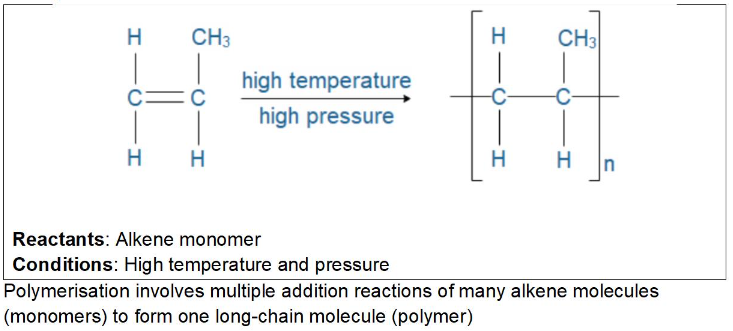
3. Polymerisation
Question 3 (Singapore Sports Sch)
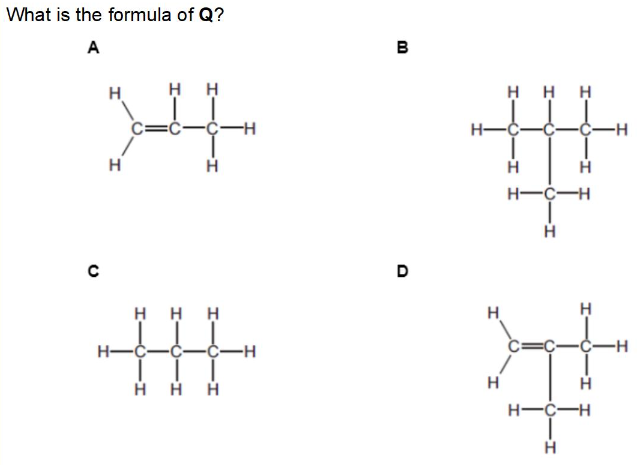
Q is a compound that:
- can be formed, as the only other product, when the alkane C8H18 is cracked to produce butane,
- decolourises bromine water,
- has a branched chain structure.
Answer
From the 1st statement, C8H18 follows the general formula of alkanes. C8H18 is cracked to form butane (C4H10) and another compound (Q = C4H8, butene).
From the 2nd statement, Q is unsaturated and has a C=C bond which decolorises bromine water. Hence, options B and C are eliminated.
From the 3rd statement, Q is a branched compound.
D is the only answer as it fits all 3 criteria.
Start Your Chemistry Tuition Journey With Achievers Dream
At Achievers dream, we offer specialised Primary Science Tuition, O Level Chemistry Tuition, Lower Secondary Science Tuition and JC Chemistry tuition. Our team consists of ex-MOE HOD’s, NIE teachers and full-time tutors.
As a top tuition centre in Singapore, students will be provided with a wide range of information from sources such as exclusive cheat sheets, sec 1 science notes, science revision guides or other supplementary/topic by topic notes.
Join Our Exclusive Telegram Group Here
Click Here for Free Access to our coloured Chemistry notes
We provide fully customised lessons in conjunction with up-to-date facilities such as our chemistry laboratory and a student portal. Our team will be there for you to support your learning journey, start now and achieve better results