
Chemical Formula for Methane (CH₄)
Methane (CH₄) may seem like a simple compound, but it plays a significant role in both O-Level and A-Level Chemistry examinations. From bonding and structure to environmental impact and organic reactions, methane frequently appears in key topics across both syllabi.
In our chemistry tuition lessons, we help students master these concepts through targeted explanations, visual aids, and practice questions, ensuring they not only understand the theory behind methane but also apply it effectively in exams.
Read on as we explain more about the intricacies of CH₄ and how it is produced in the natural environment.
The Structure of Methane (CH₄)
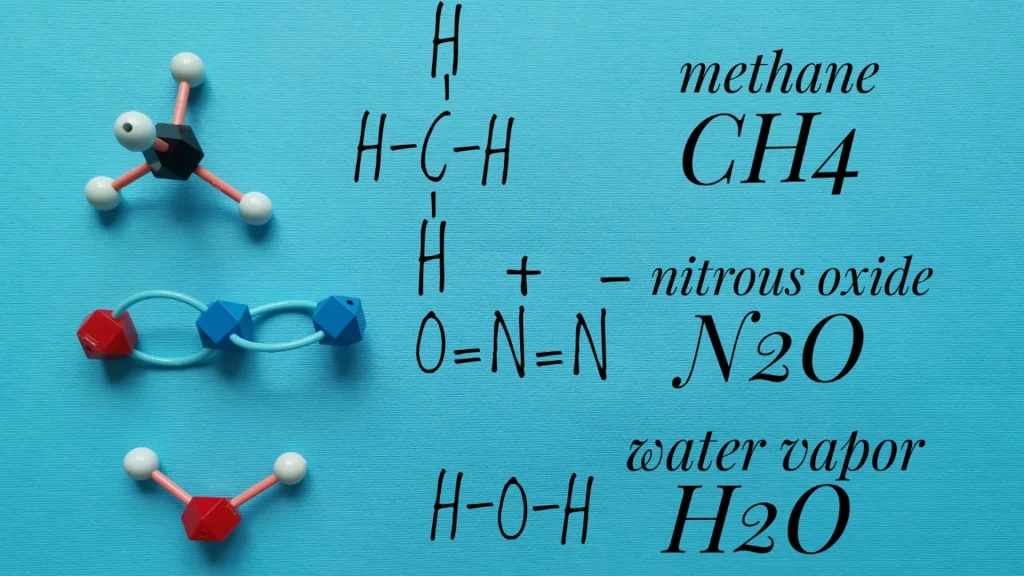
Methane, with its chemical formula CH₄, is the simplest alkane and the primary component of natural gas. Its molecular structure is composed of one carbon atom bonded to four hydrogen atoms.
How is the structure formed?
This tetrahedral configuration is a result of the sp³ hybridization of the carbon atom, where the carbon’s valence electrons are rearranged to form four equivalent hybrid orbitals.
Each of these orbitals overlaps with the 1s orbital of a hydrogen atom, resulting in four sigma (σ) bonds. The symmetry of this structure is such that it minimizes repulsion between the electron pairs, allowing for a stable and balanced molecule. (The arrangement is crucial for maintaining the molecule’s stability and minimization of potential energy.)
Properties of Methane
Methane exhibits a variety of intriguing physical and chemical properties that make it a unique and valuable substance.
As a colorless and odorless gas at room temperature and pressure, methane is often detected by its association with other substances, such as the distinctive odor added to natural gas for safety reasons:
Boiling Points and Reactions
Its low boiling point of -161.5 degrees Celsius makes it a highly volatile compound, readily transitioning between liquid and gaseous states under different environmental conditions.
- Methane becomes highly reactive at elevated temperatures, particularly in the presence of oxygen. It undergoes combustion to produce carbon dioxide and water, releasing a significant amount of energy. This exothermic reaction is the basis for methane’s use as a fuel in power generation, heating, and various industrial applications.
However, methane is also characterized by its relative inertness under normal conditions. It does not easily react with most substances at ambient temperatures, which is why it can be safely stored and transported as a component of natural gas.
Other Reactions
In addition to its combustion properties, methane can participate in a range of chemical reactions under specific conditions. For example, in the presence of a catalyst, methane can be converted to methanol or formaldehyde, both of which are valuable industrial chemicals.
- Methane also plays a role in the production of hydrogen gas through steam reforming, a process that involves reacting methane with water vapor at high temperatures. These chemical transformations highlight the versatility of methane as a raw material in the chemical industry. Understanding these properties is crucial for harnessing methane’s potential in various technological and environmental contexts.
Methane vs. Other Hydrocarbons

Comparing methane to other hydrocarbons provides valuable insights into its unique characteristics and applications. Hydrocarbons are organic compounds composed solely of carbon and hydrogen atoms, and they vary widely in their structures and properties. Methane, as the simplest hydrocarbon, serves as a reference point for understanding more complex molecules such as ethane, propane, and butane. These alkanes, like methane, belong to the saturated hydrocarbons, meaning they contain only single bonds between carbon atoms.
Alkane Series
Ethane (C₂H₆), for example, is the next member of the alkane series and consists of two carbon atoms bonded to six hydrogen atoms. While it shares some properties with methane, such as being a colorless gas at room temperature, it has a higher boiling point and is slightly less volatile. Propane (C₃H₈) and butane (C₄H₁₀) follow a similar pattern, with increasing molecular size leading to higher boiling points and greater energy content per molecule. These differences are crucial in determining the specific uses of each hydrocarbon in fuel and industrial applications.
Unsaturated Hydrocarbons
In contrast, unsaturated hydrocarbons, such as alkenes and alkynes, contain one or more double or triple bonds between carbon atoms. These compounds exhibit distinct reactivity patterns compared to methane and other alkanes.
For instance, ethylene (C₂H₄), an alkene, is widely used in the production of plastics and synthetic fibers due to its ability to undergo polymerization.
Acetylene (C₂H₂), an alkyne, is known for its use in welding and cutting torches because of the high temperature of its combustion flame.
About Crude oil And Hydrocarbons with Achievers dream Chemistry tuition free resources.
Methane’s Role in the Environment
As a potent greenhouse gas, methane has a global warming potential approximately 25 times greater than that of carbon dioxide over a 100-year period.
This means that even small concentrations of methane in the atmosphere can significantly impact climate change. Methane is released into the atmosphere through various sources, including natural processes such as the decomposition of organic matter in wetlands and anthropogenic activities like agriculture, landfills, and fossil fuel extraction.
In addition to its role as a greenhouse gas, methane is a key component of the carbon cycle, a fundamental process that regulates the flow of carbon among the Earth’s atmosphere, oceans, and terrestrial ecosystems.
- Methane emissions from natural sources are part of this cycle, as are the activities of methanotrophic bacteria that consume methane and convert it into carbon dioxide. These microbial processes help mitigate the impact of methane emissions by reducing the amount of methane that reaches the atmosphere.
Efforts to monitor and reduce methane emissions from the natural gas supply chain are critical for ensuring that this energy source contributes to sustainable development.
Engaging with methane’s multifaceted roles—from its fundamental structure and properties to its comparison with other hydrocarbons and its environmental impact—provides a thorough understanding of this vital molecule.
Start Your Chemistry Tuition Journey With Achievers Dream
At Achievers dream, we offer specialised Primary Science Tuition, O Level Chemistry Tuition, Lower Secondary Science Tuition and JC Chemistry tuition. Our team consists of ex-MOE HOD’s, NIE teachers and full-time tutors.
As a top tuition centre in Singapore, students will be provided with a wide range of information from sources such as exclusive cheat sheets, sec 1 science notes, science revision guides or other supplementary/topic by topic notes.
Join Our Exclusive Telegram Group Here
Click Here for Free Access to our coloured Chemistry notes
We provide fully customised lessons in conjunction with up-to-date facilities such as our chemistry laboratory and a student portal. Our team will be there for you to support your learning journey, start now and achieve better results