
A Level Periodic Table

Mastering the A Level Periodic Table
To a certain extent, the A level Periodic Table operates on the same level as the O-levels, but with more depth and specificity.
If you are currently an O level student, check out this article here!
Periodic Table: A Comprehensive Guide for O Level Students
The Periodic Table for A-Level Chemistry: Explaining Trends and Reactions
At H2 Chemistry level, the Periodic Table is a tool for explaining and predicting properties. It is not enough to say that atomic radius decreases across a period or that a carbonate becomes more stable down a group. You need to connect the observation to electronic configuration, nuclear attraction, structure or bonding.
This lesson focuses on the areas studied in Singapore H2 Chemistry: trends across Period 3 (sodium to chlorine) and down Group 2 (magnesium to barium) and Group 17 (chlorine to iodine).
1. Explaining Periodic Trends
A useful explanation starts by asking three questions:
- Has the nuclear charge increased?
- Are the outer electrons in the same shell or a new shell?
- How much shielding lies between those electrons and the nucleus?
Atomic radius across Period 3
From sodium to chlorine, proton number increases while the added electrons enter the same principal shell. Shielding does not increase enough to offset the greater nuclear charge. The outer electrons experience a stronger attraction to the nucleus, so atomic radius generally decreases.
Down a group, the opposite pattern dominates. Each successive element has another occupied electron shell. The outer electrons are farther from the nucleus and more strongly shielded. Atomic radius increases, even though nuclear charge also increases.
First ionisation energy
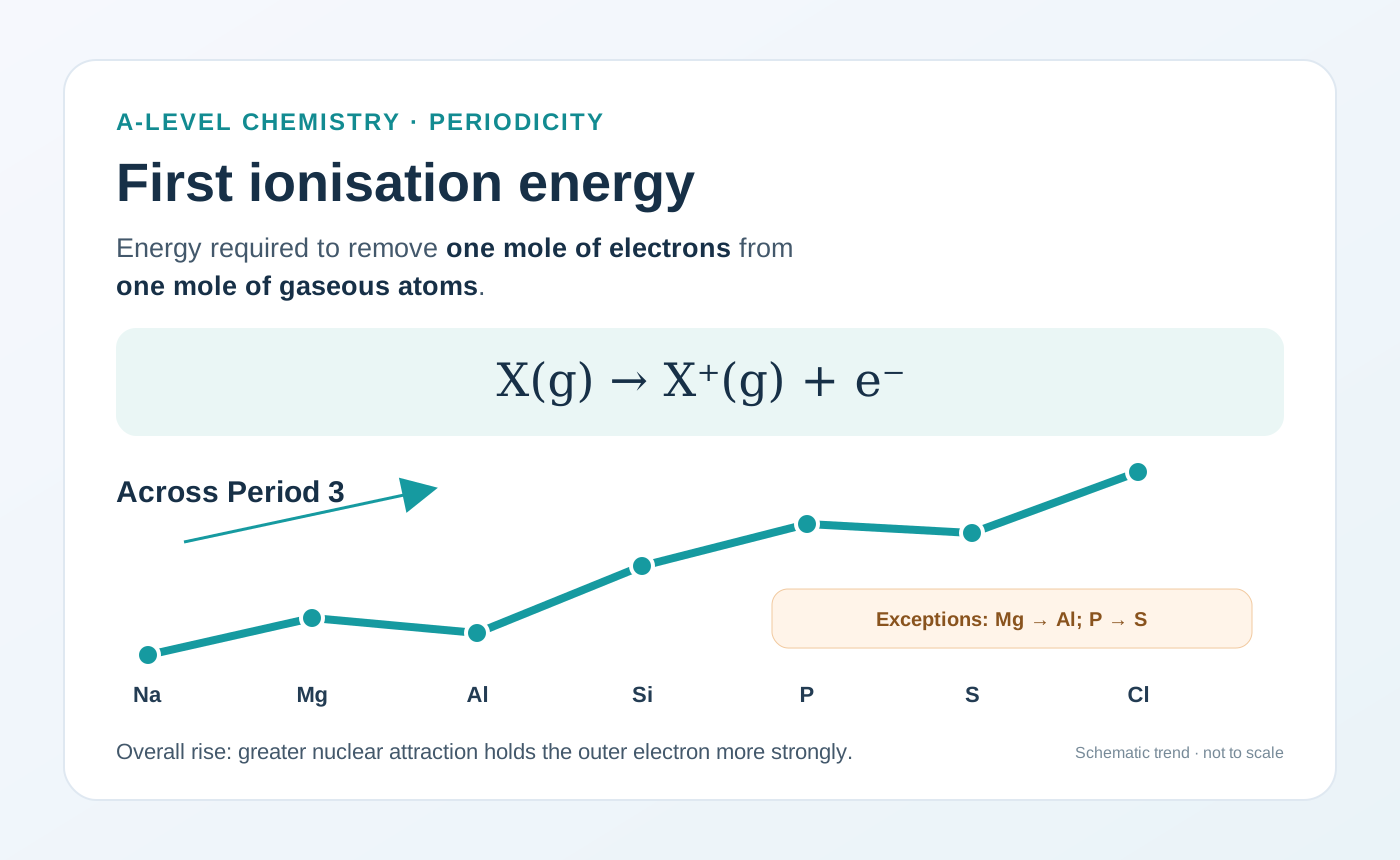
The overall trend across Period 3 is upward, but the electronic configurations of magnesium, aluminium, phosphorus and sulfur explain two exceptions.
Magnesium → Aluminium
Aluminium has a lower first ionisation energy than magnesium.
- Magnesium: outer configuration 3s2
- Aluminium: outer configuration 3s2 3p1
The electron removed from aluminium is in a higher-energy 3p orbital. It is easier to remove than a 3s electron from magnesium.
Phosphorus → Sulfur
Sulfur has a lower first ionisation energy than phosphorus.
- Phosphorus: its three 3p electrons occupy separate orbitals.
- Sulfur: one 3p orbital contains a pair of electrons.
Repulsion between the paired electrons in sulfur makes one of them easier to remove.
Down Group 2 or Group 17, the first ionisation energy generally decreases. The outer electron occupies a shell farther from the nucleus and experiences greater shielding, outweighing the increase in nuclear charge.
Ionic radius and electronegativity
Be careful when comparing ionic radii across a period. Sodium, magnesium and aluminium form positive ions by losing their outer-shell electrons. Their ions are much smaller than their atoms.
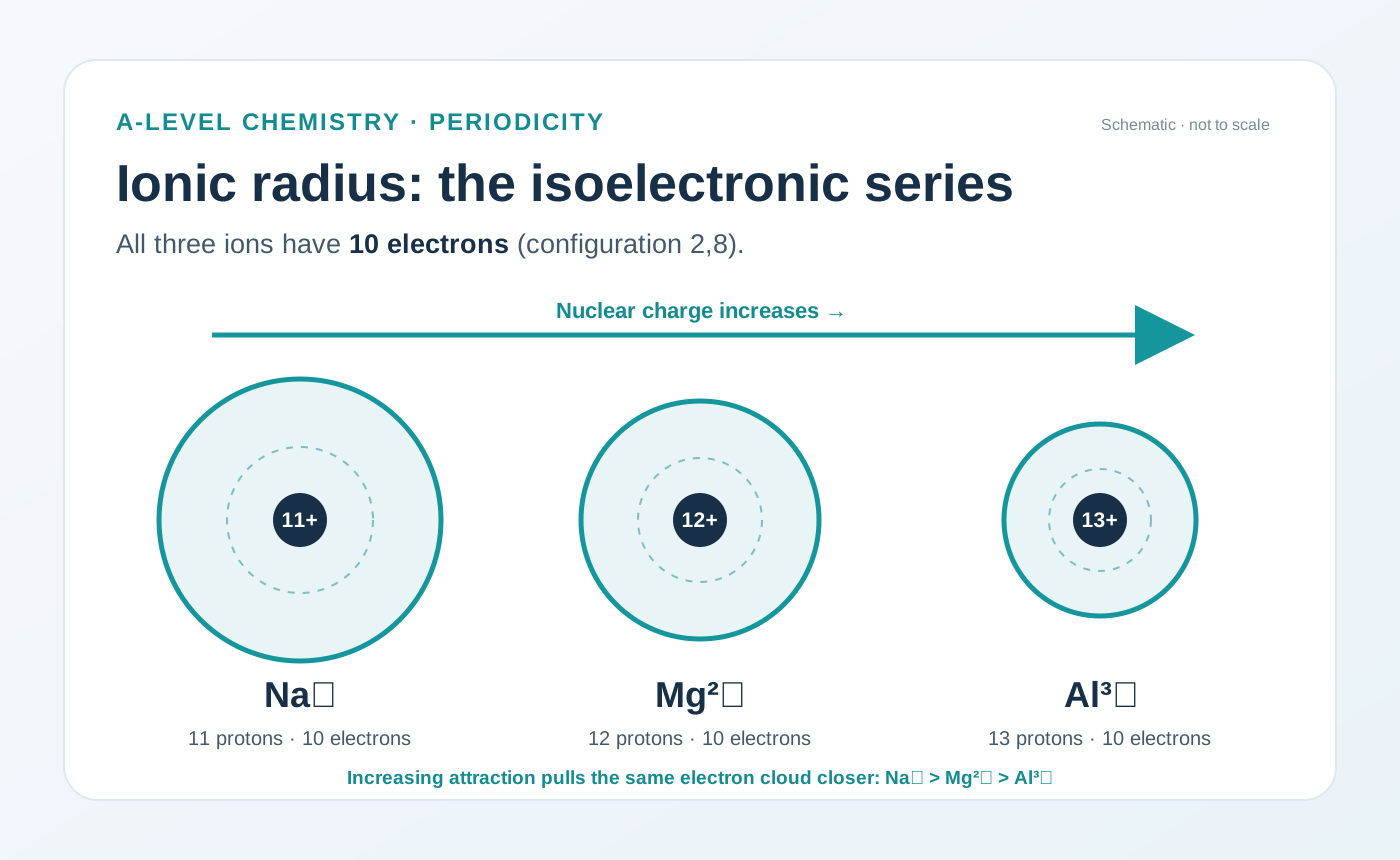
Electronegativity generally increases across Period 3 and decreases down a group. Use nuclear attraction, distance and shielding to explain the direction; avoid treating the trend as a fact to memorise in isolation.
Melting point and electrical conductivity
Electronic configuration alone cannot explain every physical trend. Across Period 3, the type of structure and bonding changes:
- Sodium, magnesium and aluminium have metallic structures. Their melting points generally rise across these three elements as metallic bonding becomes stronger.
- Silicon has a giant covalent structure. Many strong covalent bonds must be broken to melt it, giving it a very high melting point.
- Phosphorus, sulfur and chlorine are simple molecular substances. Melting overcomes intermolecular attractions rather than covalent bonds within their molecules, so their melting points are much lower than silicon’s.
The metals conduct electricity through mobile delocalised electrons. Silicon is a semiconductor; the simple molecular elements do not conduct electricity under ordinary conditions.
2. Period 3 Oxides and Chlorides: A Change in Chemical Behaviour
Across Period 3, increasing proton number is accompanied by changes in bonding and in the acid–base behaviour of compounds.
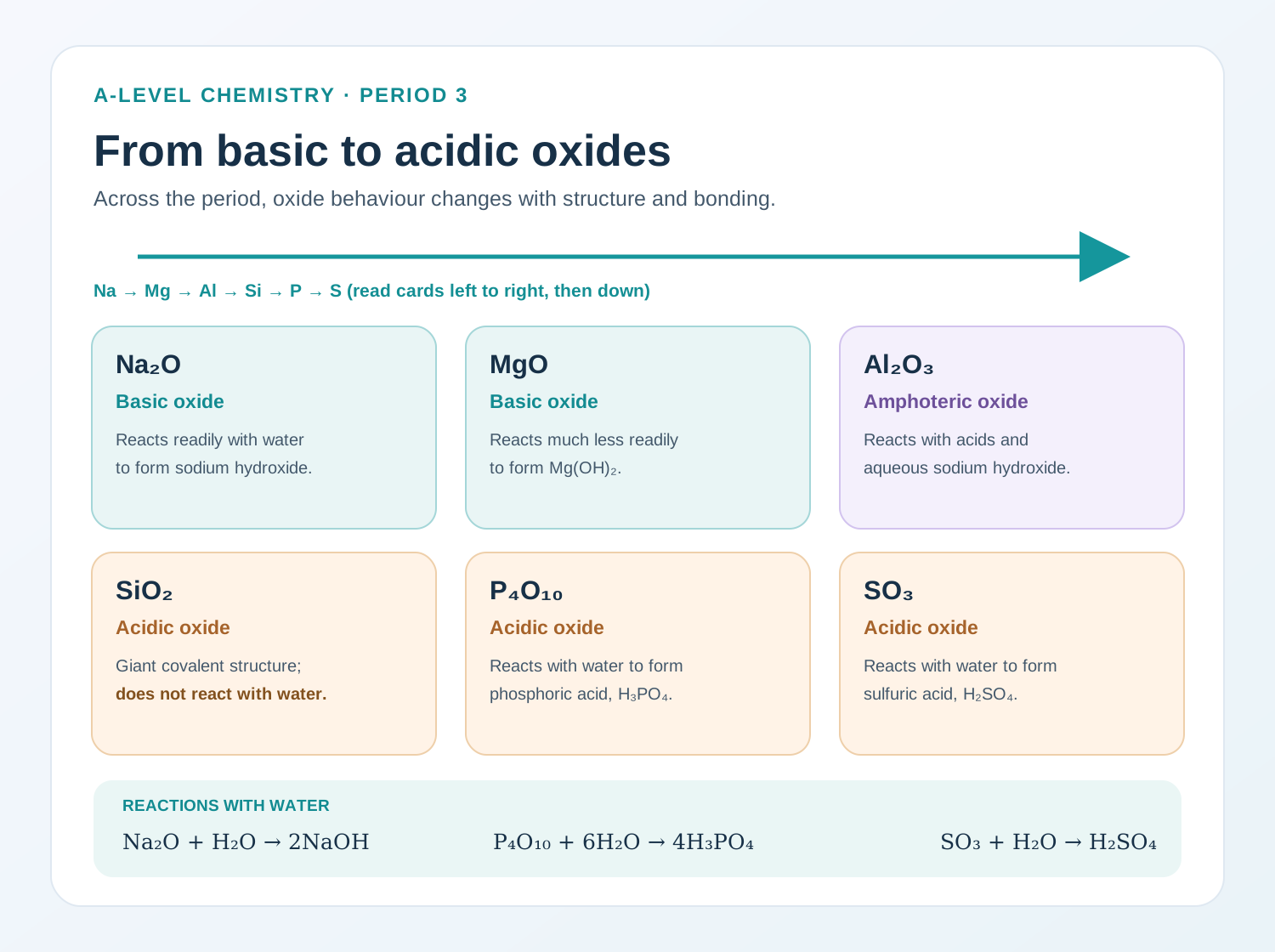
Oxides: from basic to acidic
The useful overall pattern is basic → amphoteric → acidic. In an exam explanation, name the particular oxide and describe its behaviour. The pattern does not mean every oxide reacts with water in the same way.
Chlorides and their reactions with water
Period 3 chlorides also show changing bonding and behaviour. Sodium chloride dissolves in water without significant hydrolysis. Magnesium chloride gives a slightly acidic solution because the hydrated magnesium ion hydrolyses to a limited extent. Aluminium chloride gives an acidic solution through hydrolysis of the hydrated aluminium ion.
How do Period 3 chlorides react with water?
Silicon tetrachloride
Silicon tetrachloride hydrolyses to form silicon dioxide and hydrogen chloride:
SiCl4 + 2H2O → SiO2 + 4HCl
Phosphorus pentachloride
Phosphorus pentachloride also hydrolyses. With excess water, its overall reaction is:
PCl5 + 4H2O → H3PO4 + 5HCl
Exam tip: Distinguish a chloride dissolving in water from one reacting with water. An acidic solution alone does not tell you that every chloride undergoes the same reaction or forms the same products.
3. Group 2 and Group 17: Predicting Reactivity and Stability
Thermal Stability of Group 2 Carbonates
Thermal stability increases down Group 2. This means that carbonates lower down the group are harder to decompose by heating.
- Smaller M2+ ions have a higher charge density. They polarise the carbonate ion more strongly, making decomposition easier.
- Larger M2+ ions have a lower charge density. They polarise the carbonate ion less, so the carbonate is more thermally stable.
Thermal decomposition:
MCO3(s) → MO(s) + CO2(g)
Group 17 Elements as Oxidising Agents
A halogen acts as an oxidising agent when it gains electrons:
X2 + 2e− → 2X−
Oxidising ability decreases from chlorine to iodine. Chlorine can therefore oxidise iodide ions to iodine:
Cl2 + 2I− → 2Cl− + I2
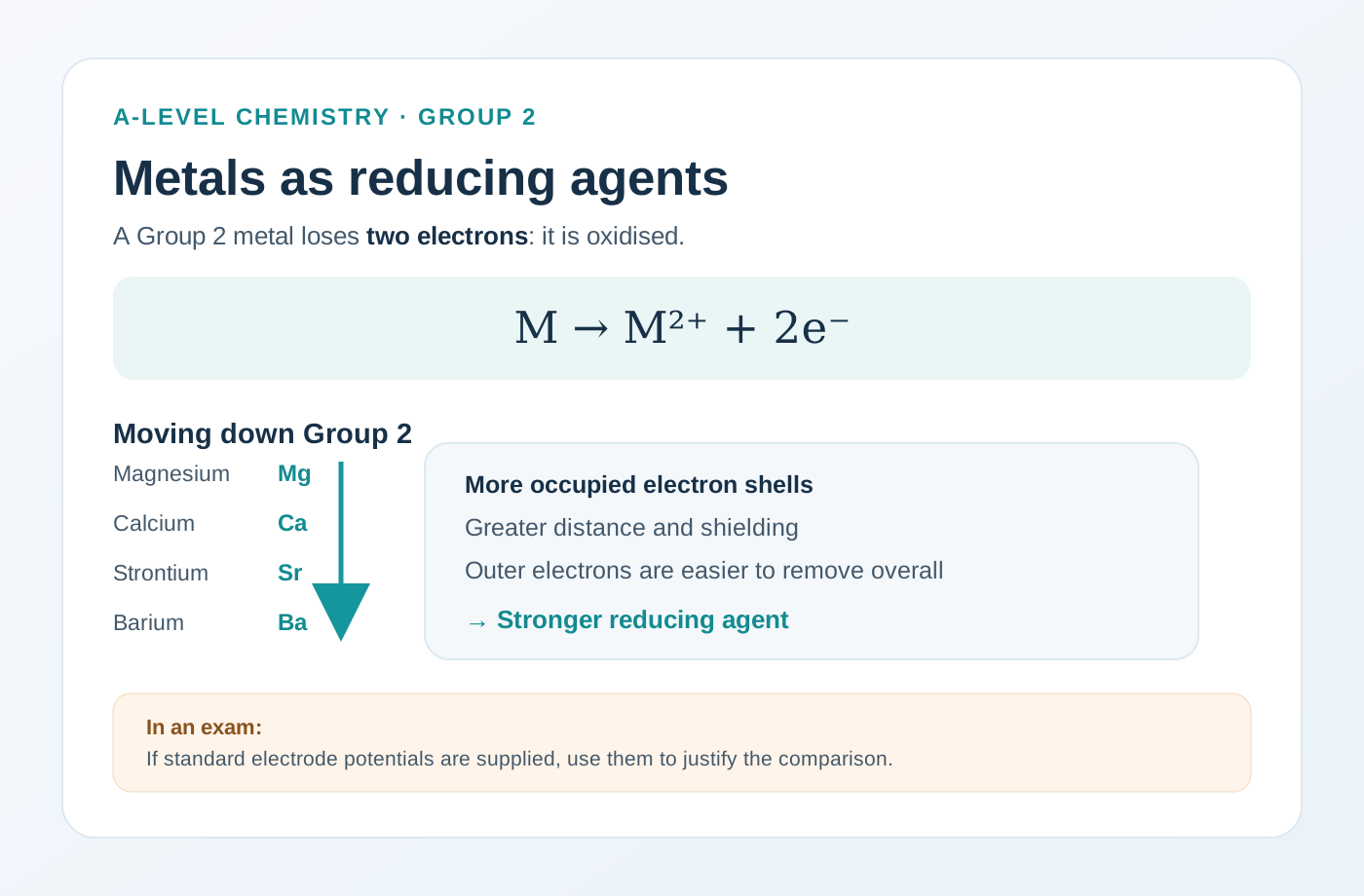
Iodine cannot displace chlorine from chloride ions. If standard electrode potentials are provided, use their values to establish the direction of the reaction.
The thermal stability of hydrogen halides decreases from HCl to HI as the H–X bond becomes weaker down the group. Separately, chlorine, bromine and iodine become less volatile down the group: their larger electron clouds give rise to stronger instantaneous dipole–induced dipole attractions between molecules. These are different trends with different explanations: one concerns a bond within a molecule; the other concerns attractions between molecules.
Worked Question 1: Exception to Ionisation Energy Trend
Question: First ionisation energy generally increases across Period 3. Explain why aluminium has a lower first ionisation energy than magnesium
Answer: Magnesium has an outer electronic configuration of (3s^2), while aluminium has (3s^2 3p^1). The first electron removed from aluminium is in a (3p) orbital, which is higher in energy than magnesium’s (3s) orbital. It is therefore easier to remove from aluminium, despite aluminium having the higher proton number.
Worked Question 2: Comparing Carbonate Stability
Question: Predict which is more thermally stable, magnesium carbonate or barium carbonate. Explain your answer.
Answer: Magnesium has an outer electronic configuration of 3s2, while aluminium has 3s2 3p1. The first electron removed from aluminium is in a 3p orbital, which is higher in energy than magnesium’s 3s orbital. It is therefore easier to remove from aluminium, despite aluminium having the higher proton number.
What the question tests: “Stability increases down Group 2” states the trend. Ion size, charge density and polarisation provide the explanation.
A level Periodic Table Cheat sheet and Periods
Start Your Chemistry Tuition Journey With Achievers Dream
At Achievers dream, we offer specialised Primary Science Tuition, O Level Chemistry Tuition, Lower Secondary Science Tuition and JC Chemistry tuition. Our team consists of ex-MOE HOD’s, NIE teachers and full-time tutors.
As a top tuition centre in Singapore, students will be provided with a wide range of information from sources such as exclusive cheat sheets, sec 1 science notes, science revision guides or other supplementary/topic by topic notes.
Join Our Exclusive Telegram Group Here
Click Here for Free Access to our coloured Chemistry notes
We provide fully customised lessons in conjunction with up-to-date facilities such as our chemistry laboratory and a student portal. Our team will be there for you to support your learning journey, start now and achieve better results