
A-Level Chemistry Practicals
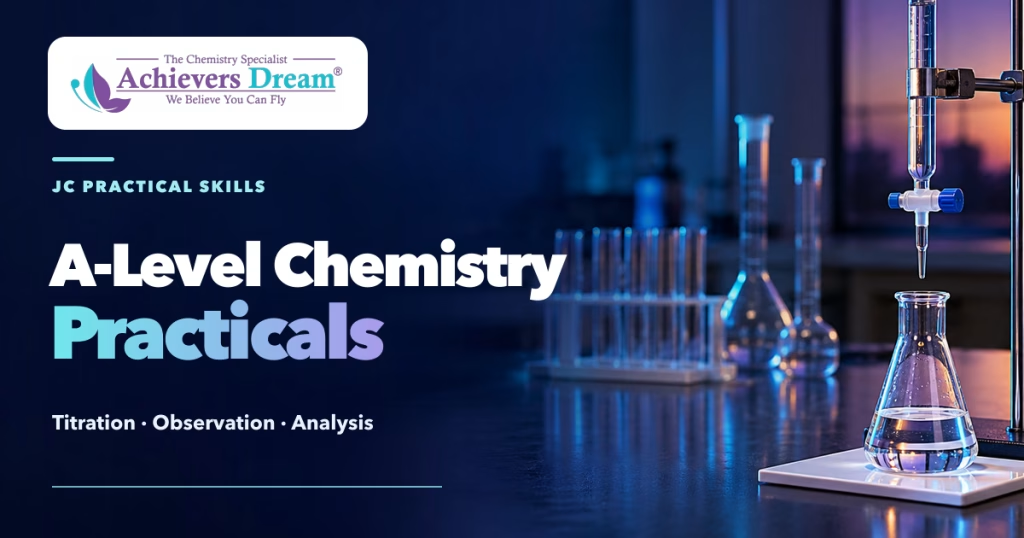
Navigating the intricate world of A-Level Chemistry Practicals can be both daunting and exhilarating, offering students a hands-on experience like no other. From titrations to calorimetry experiments, these practical sessions are where theory truly comes to life. Are you ready to dive into the realm of chemical reactions and precise measurements?
Whether it’s determining reaction rates or identifying unknown substances, A-Level Chemistry Practicals provide a unique opportunity to apply classroom knowledge in a real-world setting.
Join us as we delve into the fascinating world of A-Level Chemistry Practicals, where beakers bubble, solutions change color, and discoveries await around every corner.
A-Level Chemistry Practicals
Navigating the intricate world of A-Level Chemistry Practicals can be both daunting and exhilarating, offering students a hands-on experience like no other.
The topics tested for the A Level Chemistry Practical / H2 syllabus are:
Scope checked against the 2026 H2 Chemistry syllabus (9476). This is not an exhaustive list; examination restrictions are shown below.
If the table extends beyond its panel, swipe or scroll sideways to read all columns.
| Topics | Content Tested |
|---|---|
| 1. Titration | e.g. acid-base titration (with suitable indicators such as methyl orange, screened methyl orange, thymolphthalein and thymol blue), redox titration, iodimetric titration, indirect titration, including the preparation of standard solutions. Other types of titrations may also be required, where appropriate, sufficient working details will be given |
| 2. Gravimetric analysis | e.g. volatilisation gravimetry |
| 3. Gas collection | Gas collection by displacement of water or using gas syringes is not required during the practical examination. |
| 4. Thermochemistry | including thermometric titration |
| 5. Chemical kinetics | continuous and initial rate methods |
| 6. Qualitative inorganic analysis involving an element, a compound or a mixture | Systematic analysis will not be required. Candidates should be familiar with the reactions of cations, reactions of anions and test for gases as detailed in the Qualitative Analysis Notes.Candidates would not be required to carry out tests involving hexane, sulfur dioxide gas, nitrite ions or sulfite ions.
Reactions involving ions not included in the Qualitative Analysis Notes may be tested: in such cases, candidates will not be expected to identify the ions but only to draw conclusions of a general nature. |
| 7. Qualitative organic analysis | e.g. test-tube reactions indicating the presence of unsaturation (C=C), alcoholic, phenolic, carbonyl, carboxyl and amino groups, may be set. Candidates should know the syllabus reactions and the organic tests in the Qualitative Analysis Notes. Tests using 2,4-dinitrophenylhydrazine, phosphorus(V) chloride or phenol are not required. |
| 8. Simple organic synthesis and purification | including use of water bath, setting up and use of reflux and distillation apparatus.Conducting a large-scale organic synthesis involving reflux, distillation and purification would not be expected during the practical examination. |
Common A-Level Chemistry Practical Experiments
A-Level Chemistry Practical Experiments encompass a wide variety of techniques that are essential for understanding chemical principles.
- One of the most common experiments is titration, a process used to determine the concentration of a solution. During a titration, students carefully add a solution of known concentration to a solution of unknown concentration until the reaction reaches its endpoint, often indicated by a color change. Mastering this technique is crucial, as it lays the groundwork for quantitative analysis in chemistry, allowing students to develop a strong foundation in analytical skills.
- Gas-law investigations can explore the properties of gases, such as Boyle’s law and Charles’s law. These experiments involve measuring the volume, temperature, and pressure of gases to demonstrate the relationships between these variables. These are learning examples, not predictions of a particular examination task.
A-Level Chemistry Practical Assessment Criteria
Candidates are expected to:
- follow a detailed set or sequence of instructions and use techniques, apparatus and materials safely and effectively
- make, record and present observations and measurements with due regard for precision and accuracy
- interpret and evaluate observations and experimental data
- identify a problem, devise and plan investigations, select techniques, apparatus and materials
- evaluate methods and techniques, and suggest possible improvements.
The assessment of A-Level Chemistry Practicals is a crucial aspect of the curriculum, designed to evaluate students’ practical skills, data analysis, and understanding of scientific concepts. One of the primary criteria is the ability to plan and conduct experiments effectively. This includes formulating a hypothesis, selecting appropriate methods, and ensuring accurate measurements. Students are expected to demonstrate a clear understanding of the scientific method, which is essential for successful experimentation.
Safety Measures in Chemistry Practicals
Safety is paramount in any chemistry laboratory, and A-Level students must be well-versed in the necessary precautions to ensure a safe working environment.
Before conducting any experiment, students should familiarize themselves with the Safety Data Sheets (SDS), previously called Material Safety Data Sheets (MSDS) for each chemical they will be using. These documents provide crucial information regarding the hazards associated with specific substances, as well as guidelines for safe handling, storage, and disposal. Understanding the properties of chemicals not only promotes safety but also enhances students’ comprehension of the substances they are working with.
Personal protective equipment (PPE) is a fundamental aspect of laboratory safety. Students should wear suitable eye protection and the protective clothing required by their laboratory. Gloves should be selected and worn when required by the experiment’s risk assessment and the teacher’s instructions. This protective gear minimizes the risk of exposure to harmful chemicals and physical hazards.
Online Resources for A-Level Chemistry Practicals
In the digital age, students have access to a plethora of online resources that can enhance their understanding of A-Level Chemistry Practicals.
- One invaluable resource is virtual lab simulations, which allow students to conduct experiments in a safe and controlled environment. Platforms like Labster provide interactive simulations covering a wide range of topics, from titrations to organic synthesis. These virtual labs enable students to practice their skills and concepts without the limitations of a physical laboratory, supporting conceptual practice. Access requires suitable technology and platform access; simulations do not replace supervised hands-on laboratory practice.
- Achieversdream provides an assortment of free practical tips through youtube as well as A Level Chemistry Practical specialised classes for JC students.
- Educational websites and online forums also serve as excellent resources for students seeking assistance with practical experiments. While unconventional, online forums like Reddit’s Chemistry may help students discuss common difficulties. Confirm examination requirements using the official syllabus and your teacher’s guidance.
Start Your Chemistry Tuition Journey With Achievers Dream
At Achievers dream, we offer specialised Primary Science Tuition, O Level Chemistry Tuition, Lower Secondary Science Tuition and JC Chemistry tuition. Our team consists of ex-MOE HOD’s, NIE teachers and full-time tutors.
As a top tuition centre in Singapore, students will be provided with a wide range of information from sources such as exclusive cheat sheets, sec 1 science notes, science revision guides or other supplementary/topic by topic notes.
Join Our Exclusive Telegram Group Here
Click Here for Free Access to our coloured Chemistry notes
We provide fully customised lessons in conjunction with up-to-date facilities such as our chemistry laboratory and a student portal. Our team will be there for you to support your learning journey, start now and achieve better results